|
VALVE PROVING SYSTEM |
|
|
By activating the valve proving system, it is possible to check for any leaks in one of the fuel solenoid valves, preventing the burner from starting. This verification is required by the EN13577-2 and EN 676 standards for burners with capacities greater than 1200 kW and by NFPA 86 for burners with capacities greater than 117 kW (or 400,000 BTU/hour). The tightness of the pipework and the fuel solenoid valves can be performed: - at burner start (before the prepurge) - after a controlled shutdown, lockout or failure (before postpurge) - both, before the startup and after the shutdown of the burner |
|
|
|
Before start-up The fuel pressure switch is set at half the inlet pressure. The safety valve is opened for the time set in parameter T01, by setting SKIP TEST no leakage test will be performed. During this time the fuel fills the test volume, after which the safety valve is released and the test volume remains sealed full. The test volume remains sealed full for the time set with parameter T02. A possible leak of the outlet valves will cause the emptying of the test volume with intervention of the fuel pressure switch and consequent lockout. If the fuel pressure switch does not trip, the downstream valve(s) and pipework have passed the leak test. Parameter T04 defines which valves will be activated for fuel discharge into the combustion chamber or for venting into the atmosphere. These valves will be activated for the time set by parameter T03. The test volume remains sealed without fuel for the time set with parameter T05. A possible leak of the upstream valve would lead to the filling of the test volume with intervention of the pressure switch and consequent lockout. If the pressure switch does not trip, the upstream valve has passed the leak test. |
|
|
|
|
|
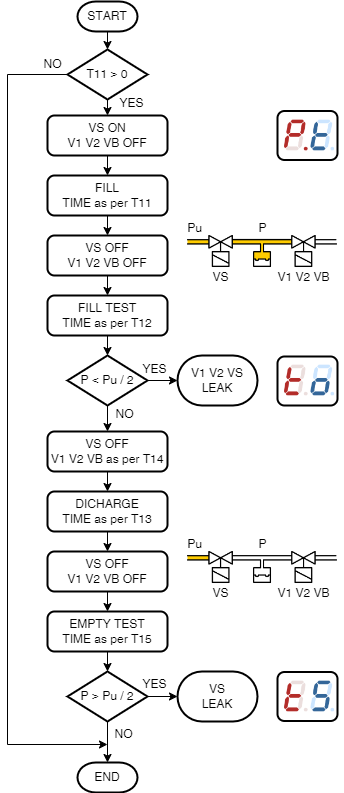
After shutdown The pressure switch is set at half the inlet pressure. The safety valve is opened for the time set in parameter T11, by setting SKIP TEST no leakage test will be performed. During this time the fuel fills the test volume, after which the safety valve is released and the test volume remains sealed full. The test volume remains sealed full for the time set with parameter T12. A possible leak of the outlet valves will cause the emptying of the test volume with intervention of the pressure switch and consequent lockout. If the fuel pressure switch does not trip, the downstream valve(s) and pipework have passed the leak test. Parameter T14 defines which valves will be activated for fuel discharge into the combustion chamber or for venting into the atmosphere. These valves will be activated for the time set by parameter T13. The test volume remains sealed without fuel for the time set with parameter T15. A possible leak of the upstream valve would lead to the filling of the test volume with intervention of the pressure switch and consequent lockout. If the pressure switch does not trip, the upstream valve has passed the leak test. |
|
|
|
|
|
|
Q2