|
FLAMELESS OPERATION |
||
|
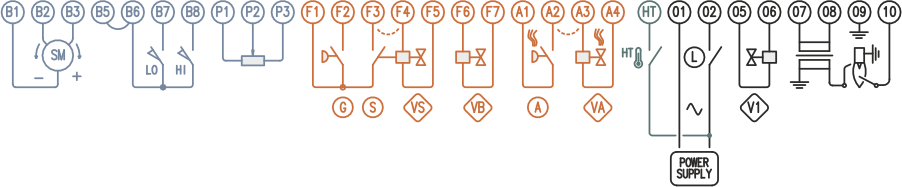
In a flameless burner, the flame front is deliberately avoided and combustion reactions occur when fuel and air are mixed together with entrained and recirculated combustion products, this significantly reduces NOx emissions. For the process to take place, the combustion products must be above the self-ignition temperature (> 850°C for safety). The ignition of the burner takes place as for any low temperature burner. Once the self-ignition temperature is reached, the high temperature mode is activated for which there are two stages. For each of these stages it is possible to define the behaviour of the valves which will activate and deactivate the fuel flow in order to obtain the desired behaviour. In the typical application, stage 5 is used as a transition during which, to ensure flame extinction, all valves are closed, subsequently moving to stage 6, where the specific valves for staged operation are opened. Remote commands allow switching between these two stages, essentially allowing an on/off control in flameless mode. |
||
|
|
|
|
|
|
||
|
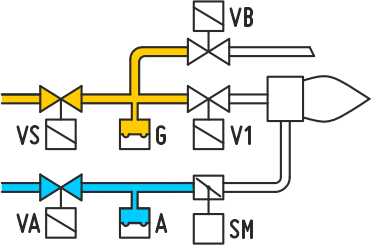
GAS staged burner The V1 valve is active during the low temperature stage, once the self-ignition temperature is reached it will be switched off to activate - with a possible intermediate stage - the VB valve which injects gas directly into the combustion chamber. The SM actuator can be used to change the airflow. |
|
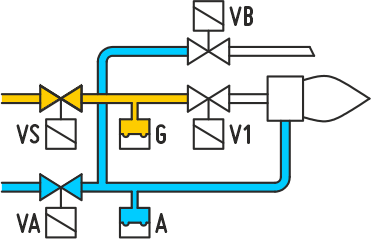
AIR staged burner When the self-ignition temperature is reached, the VB valve will be activated which injects additional air into the combustion chamber. Different configura-tions for the air valves are also possible. Optionally the V2 valve can be used to activate a different fuel flow. |
Q2