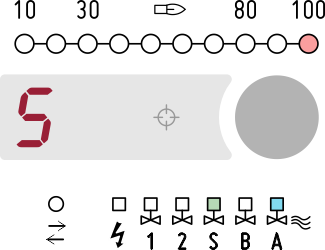
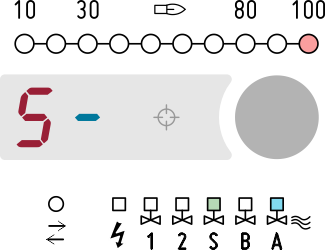
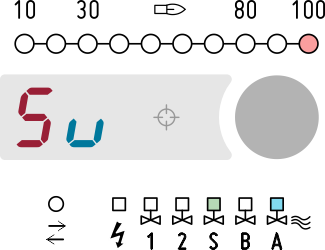
|
STAGE 5 |
|
|
This stage is reached when the HT input is activated. The transition can take place immediately from a low temperature stage (2, 3 or 4) or when the burner is restarted, depending on parameter G08. This could be the low to high temperature transition during which the behaviour of all fuel valves and the air valve can be defined. . |
|
|
The presence of fuel and air can be verified by activating the pressure switches, defining their reaction time (to tolerate any short drops in pressure) |
|
|
The duration of this stage before moving on to stage 6 can be set. Set this stage as continuous if this is the only high temperature operating stage. This stage can be terminated by: • manual shutdown • controlled shutdown • HT signal removal (see below) • lockout |
|
|
It is also possible to define a minimum duration during which any controlled shutdown requests are ignored. Parameter 506 defines the behaviour when the HT signal is removed: • move to controlled shutdown • move to pre-ignition • move to low temperature stage 2 • move to low temperature stage 3 • move to low temperature stage 4 |
|
|
The transition to any other high temperature stage can be managed with remote control. Parameters 507 and 508 define the behaviour in the event of air pressure failure and fuel pressure failure: • lockout • re-ignition • recycle from the beginning After post-purge stage, if set and due. |
|
|
The actuator position can be preset and even changed remotely.
|
|
|
The LED 100 of the flame signal bargraph is blinking when in high temperature mode. |
|
|
Allowed remote commands H R S s A a O o f L D d Dxx
6 |
|
Q2