|
ACTUATOR |
|
|
A three-point actuator in combination with a butterfly valve can be connected for staged or modulating burner capacity control. To detect any anomalies during operation, parameter G01 is set with the maximum time required to cover the complete travel. |
|
|
|
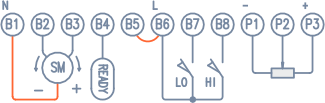
If the actuator power supply voltage is the same as that of the device and loads, take the power supply phase from terminal B6 by connecting it to terminal B5 and connect the actuator neutral to terminal B1. |
|
|
|
|
|
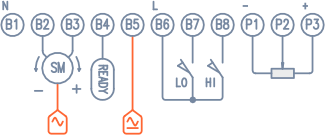
If the actuator is powered separately, connect one end of the power supply to terminal B5 and the other end to the actuator neutral (common return). |
|
Voltage will be present at terminal B2 when closing is requested. Voltage will be present at terminal B3 when opening is requested. |
|
|
|
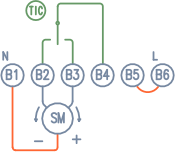
Voltage at terminal B4 will only be present when the actuator is not moving and is not forced into the closed or open position. This output can be used as consent for an optional external thermoregulator as shown in the figure. When the actuator is not controlled by Q2, terminal B4 supplies voltage to external regulator (TIC) which can operate the contacts to request closing or opening. |
|
Limit switches In addition to the open and close outputs of the actuator, it is necessary to connect the limit switches which define:
These contacts are internally powered at the same supply voltage used for the device and the loads. Before starting the pre-purge and post-purge phases it will be possible to force the complete opening of the actuator to guarantee the maximum flow of air, while before proceeding with burner ignition it will be possible to force the closed position. Potentiometer If the actuator is equipped with a potentiometer it will be possible to set predefined positions in each step of the program. A voltage of 5V is supplied to terminals P1 (negative) and P3 (positive) while the potentiometer feedback is connected to terminal P2. The potentiometer can have a resistance value between 100 Ω and 10 kΩ. 0% and 100% are the positions of the closed and open limit switches respectively and within this range the actuator can be positioned simply by indicating the opening percentage. It is also possible to define arbitrary positions of the 1% and 99% limits in order to adapt the linear regulation range to specific needs. |
|
|
|
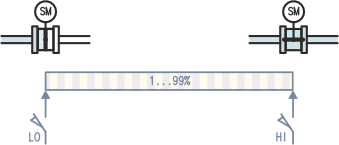
Typical configuration: the limits of the actuator travel are between the position of the LO limit switches (0% which usually defines the minimum for ignition) and that of the HI limit switch (100% which defines the maximum for purge). The travel from 1 to 99% develops entirely within the two limit switches. |
|
|
|
|
|
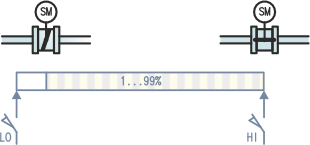
The fully closed position set for the potentiometer (corresponding to 1%) is higher than the position of the LO limit switch, while the fully open position (99%) corresponds to that of the HI limit switch. Useful when the minimum flow rate during operation (LO limit switch) can be reduced below the minimum required for the ignition (1% of the potentiometer). |
|
|
|
|
|
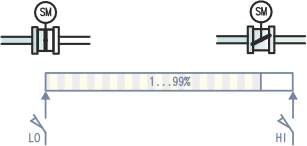
The fully open position set for the potentiometer (corresponding to 99%) is lower than the position of the HI limit switch, while the fully closed position (1%) corresponds to that of the LO limit switch. Useful when the flow rate during operation is reduced (99%) respect to the one set for prepurge (HI limit switch). |
|
|
|
|
|
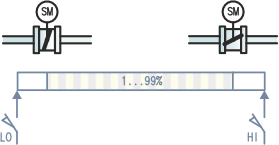
Both limit positions set for the potentiometer (1% and 99%) are different from the limits set by the limit switches (LO and HI). Useful when the process requires that in particular conditions a minimum flow rate and a maximum flow rate outside the typical regulation range must be reached. |
|
This makes it possible to create applications in which each operating phase can be associated with an actuator position both for capacity control or cooling operations:
The limit switch activation point is defined by suitably positioning the servomotor cams. The travel limits of the actuator can be set during the commissioning phase: the actuator is moved manually and when the required flow is reached, the position is stored.
|
|
Q2